Ever since I switched from reading Time magazine to The Economist, I feel like I now learn more in one week’s edition of The Economist than I did reading a year’s worth of Time. I’m learning some random things like how Tajikistan, a country still trying to discover itself after a civil war in 1997 and whose economy is dependent on exports of copper and cotton, is a place to watch for the Taliban to possibly move into next, how Vietnam has a weak financial system and how Indonesia seems to be much more politically sound than Thailand…. and how GDI is probably a better indicator of economic health than GDP, how 7% of Best Buy’s customers account for 43% of its sales, the general nonchalance over devaluation of currency, and how we may try to inflate our way out of national debt. Oh, and I discovered this stunning video of a 7 hour train ride from Bergen to Oslo. The 10 minute clip is “from Finse where the scenes from Hoth in Star Wars Episode V: The Empire Strikes Back were filmed.”
From my reading (and this is pure speculation only), I don’t trust Sweden (too liberal for me), Spain, Italy, and Greece, and Sub-Saharan Africa sounds like a better place to invest in than India. Oh and how the hell does Norway have a budget % of GDP surplus (10.5%), which is higher than Saudi Arabia (1.7%)?
Anyway, here’s the latest of one of my favorite articles:
Gendercide: The worldwide war on baby girls
“We had scarcely sat down in the kitchen”, she writes (see article), “when we heard a moan of pain from the bedroom next door…The cries from the inner room grew louder—and abruptly stopped. There was a low sob, and then a man’s gruff voice said accusingly: ‘Useless thing!’
“Suddenly, I thought I heard a slight movement in the slops pail behind me,” Miss Xinran remembers. “To my absolute horror, I saw a tiny foot poking out of the pail. The midwife must have dropped that tiny baby alive into the slops pail! I nearly threw myself at it, but the two policemen [who had accompanied me] held my shoulders in a firm grip. ‘Don’t move, you can’t save it, it’s too late.’
…
Within ten years, the academy said, one in five young men would be unable to find a bride because of the dearth of young women—a figure unprecedented in a country at peace.
The number is based on the sexual discrepancy among people aged 19 and below. According to CASS, China in 2020 will have 30m-40m more men of this age than young women. For comparison, there are 23m boys below the age of 20 in Germany, France and Britain combined and around 40m American boys and young men. So within ten years, China faces the prospect of having the equivalent of the whole young male population of America, or almost twice that of Europe’s three largest countries, with little prospect of marriage, untethered to a home of their own and without the stake in society that marriage and children provide.
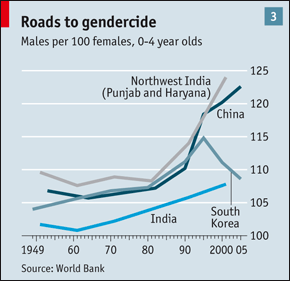
Gendercide—to borrow the title of a 1985 book by Mary Anne Warren—is often seen as an unintended consequence of China’s one-child policy, or as a product of poverty or ignorance. But that cannot be the whole story. The surplus of bachelors—called in China guanggun, or “bare branches”— seems to have accelerated between 1990 and 2005, in ways not obviously linked to the one-child policy, which was introduced in 1979. And, as is becoming clear, the war against baby girls is not confined to China.
Parts of India have sex ratios as skewed as anything in its northern neighbour. Other East Asian countries—South Korea, Singapore and Taiwan—have peculiarly high numbers of male births. So, since the collapse of the Soviet Union, have former communist countries in the Caucasus and the western Balkans. Even subsets of America’s population are following suit, though not the population as a whole.
The real cause, argues Nick Eberstadt, a demographer at the American Enterprise Institute, a think-tank in Washington, DC, is not any country’s particular policy but “the fateful collision between overweening son preference, the use of rapidly spreading prenatal sex-determination technology and declining fertility.” These are global trends. And the selective destruction of baby girls is global, too.
Boys are slightly more likely to die in infancy than girls. To compensate, more boys are born than girls so there will be equal numbers of young men and women at puberty. In all societies that record births, between 103 and 106 boys are normally born for every 100 girls. The ratio has been so stable over time that it appears to be the natural order of things.
In China the sex ratio for the generation born between 1985 and 1989 was 108, already just outside the natural range. For the generation born in 2000-04, it was 124 (ie, 124 boys were born in those years for every 100 girls). According to CASS the ratio today is 123 boys per 100 girls. These rates are biologically impossible without human intervention.
…
The sex ratio of 15-year-olds in 2005 was not far from the sex ratio at birth in 1990. The implication is that sex-selective abortion, not under-registration of girls, accounts for the excess of boys.
…
South Korea is experiencing some surprising consequences. The surplus of bachelors in a rich country has sucked in brides from abroad. In 2008, 11% of marriages were “mixed”, mostly between a Korean man and a foreign woman. … The children are common enough to have produced a new word: “Kosians”, or Korean-Asians.
…
As a Hindu saying puts it, “Raising a daughter is like watering your neighbours’ garden.”
…
One third of [women in India] without children said a son, two-thirds had no preference and only a residual said a daughter. Polls carried out in Pakistan and Yemen show similar results. Mothers in some developing countries say they want sons, not daughters, by margins of ten to one. In China midwives charge more for delivering a son than a daughter.
…
In China, the higher a province’s literacy rate, the more skewed its sex ratio. The ratio also rises with income per head.
…
So, with rising incomes and falling fertility, more and more people live in the smaller, richer families that are under the most pressure to produce a son.
…
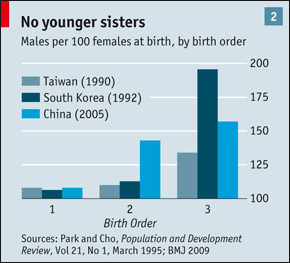
For an example, take Guangdong, China’s most populous province. Its overall sex ratio is 120, which is very high. But if you take first births alone, the ratio is “only” 108. That is outside the bounds of normality but not by much. If you take just second children, however, which are permitted in the province, the ratio leaps to 146 boys for every 100 girls. And for the relatively few births where parents are permitted a third child, the sex ratio is 167. Even this startling ratio is not the outer limit. In Anhui province, among third children, there are 227 boys for every 100 girls.
The crime rate has almost doubled in China during the past 20 years of rising sex ratios, with stories abounding of bride abduction, the trafficking of women, rape and prostitution. A study into whether these things were connected† concluded that they were, and that higher sex ratios accounted for about one-seventh of the rise in crime.
…
During the 1990s, China saw the appearance of tens of thousands of “extra-birth guerrilla troops”—couples from one-child areas who live in a legal limbo, shifting restlessly from city to city in order to shield their two or three children from the authorities’ baleful eye. And, according to the World Health Organisation, female suicide rates in China are among the highest in the world (as are South Korea’s). Suicide is the commonest form of death among Chinese rural women aged 15-34; young mothers kill themselves by drinking agricultural fertilisers, which are easy to come by. The journalist Xinran Xue thinks they cannot live with the knowledge that they have aborted or killed their baby daughters.
Some of the consequences of the skewed sex ratio have been unexpected. It has probably increased China’s savings rate. This is because parents with a single son save to increase his chances of attracting a wife in China’s ultra-competitive marriage market. … They calculate that about half the increase in China’s savings in the past 25 years can be attributed to the rise in the sex ratio. If true, this would suggest that economic-policy changes to boost consumption will be less effective than the government hopes.
…
South Korea was the first country to report exceptionally high sex ratios and has been the first to cut them. Between 1985 and 2003, the share of South Korean women who told national health surveyors that they felt “they must have a son” fell by almost two-thirds, from 48% to 17%.
…
It is just possible that China and India may be reaching that point now. The census of 2000 and the CASS study both showed the sex ratio stable at around 120. At the very least, it seems to have stopped rising.