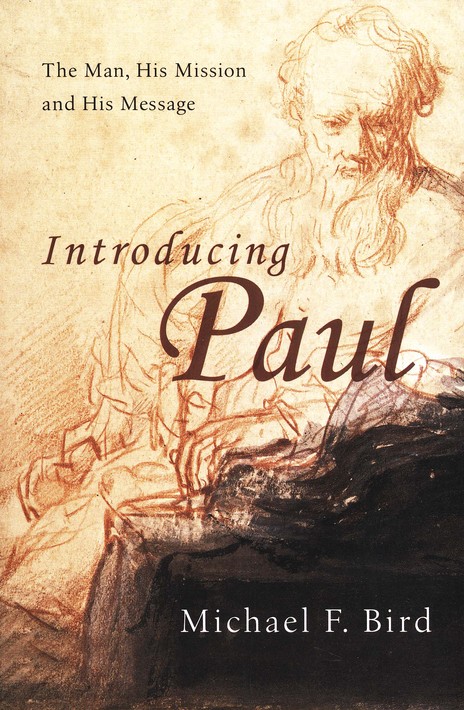
Michael F. Bird – Introducing Paul
Michael Bird is now one of my favorite theological authors (to be distinguished from theologian). By that I mean, I don’t know whether I’d like the way he would argue as a theologian, but he is better than any other author I’ve read when it comes to summarizing difficult theological topics. This book is an essential read for anyone who is interested in being introduced to how to incorporate both the Reformed and New-Perspective view of Paul. I also loved his concluding thoughts at the end of the book, Four Views on the Apostle Paul (Counterpoints: Bible and Theology), which summarized 4 overlapping yet distinct viewpoints from Reformed, Catholic, Post-New Perspective, and Jewish scholars very well.
What Bird succinctly does so well in the short 160 page book he does even better in this great interview about his book, Introducing Paul, in the Gospel Coalition website. Some quotes from the website:
When you read the account of his conversion in Galatians 1, Philippians 3, and 1 Corinthians 15 (especially 1 Corinthians 15:10 – ”But by the grace of God I am what I am, and his grace to me was not without effect. No, I worked harder than all of them– yet not I, but the grace of God that was with me”), you get the feeling that Paul knew that God had every reason available not to save him, but nonetheless, He still decided to do so. There was nothing about Paul that made him more saveable than anyone else. To the contrary and by his own admission, he was the last person worthy of salvation.
Thus Paul’s narration of his conversion, I think, is the best example of the catch-cry sola gratia (grace alone) that I can find in the entire New Testament.
Where the New Perspective on Paul is correct is in emphasizing the social dimension of Paul’s debates and concerns. Paul’s debates about works of law and justification by faith, were not abstract debates about “what must I do to be saved?” but really came down to the matter, “Do Gentiles have to become Jews in order to become Christians?”.
To claim that one gains a righteous status by “works of law” is both legalistic andethnocentric. I think the NPP provides us with a bit more social realism in our handling of Paul and his letters and keeps us grounded in the socio-religious realities of the first century.
To give another example, I often ask my students, why was Jesus cursed on the cross (Gal. 3.13)? They often say things like: “so we could go to heaven”, “so we could have a relationship with God”, “so we would be saved” – all these answers tend to revolve around personal, vertical, and individual soteriology.
I then ask them, “Why did Paul think that Jesus was cursed on the cross?” The answer being in Galatians 3:14 – ” He redeemed us in order that the blessing given to Abraham might come to the Gentiles through Christ Jesus, so that by faith we might receive the promise of the Spirit.”
Some of my favorite quotes from the book, Introducing Paul :
While it sounds so general as to be meaningless, it may be better to say that ‘Jesus Christ’ is the centre of Paul’s theology. Christ is central in Paul’s religious experience, proclamation and pastoral care. If we wanted to pursue something more specific, we could legitimately suggest that the death and resurrection of Jesus Christ are the main coordinates of his thinking, which would come close to identifying the central theological thread in Paul’s gospel (22).
We often thank God for Paul the theologian and Paul the missionary pioneer. I believe we can also thank God for Paul the pastor, who so demonstrated his care that his churches grew, and left an example so that the church continues to mature. (26)
To be zealous meant a willingness to use violence against other Jews who threatened the sanctity of Israel’s separation from Gentiles. For example, during Israel’s wilderness wanderings, the priest Phinehas manifested ‘zeal’ by killing an Israelite man who was having intercourse with a foreign woman (Num. 25:11). (33)
[1 Corinthians 15:8 ESV – Last of all, as to one untimely born, he appeared also to me.] That phrase ‘one untimely born’ is the same word used for an abortion or miscarriage (ektroma). This violent image Paul uses to describe his own experience pertains to an endangered infant being ripped out of the womb and brought into the light. (34).
Paul was converted from the Pharisaic sect to a messianic sect within Judaism. (35).
Whereas many Jews believed that God’s wisdom was incarnated in the law of Moses (Sir. 24. 1-23; Bar. 3.29 – 4.1; 4 Macc 1.16-17), Paul came to believe that Christ is the embodiment of God’s wisdom (1 Cor. 1:30). As the Jewish scholar Claude Montefiore put it, ‘Christianity is not the Law plus Christ. It is Jesus Christ alone.” (37).
A crucial point to take away is that in Paul’s letters there is no indication that he played off the ‘Christ of Faith’ against the ‘Jesus of History.’ The fulcrum of his Christology is the identification of the crucified Jesus with the risen and exalted Lord. (55).
The ekklesia, then, is the people of God, called to be the new Israel and the renewed humanity (e. g. Col. 3:1-17). The church was to be charismatic (Spirit-endowed), multi-ethnic (jew and Gentile), Christocentric (Lord’s Supper, baptism and imitation of Christ), unified (baptized into one body), part of society (mission) but not a reflection of it (holiness). (56).
The gospel, then, is the climactic scene in the stories of God and God’s Son. Some might object that this fascination with narrative theology is simply an offshoot of postmodernity that eschews logic in favour of story. Not so. Consider this quote form Martin Luther: The gospel is a story about Christ, God’s and David’s Son, who died and was raised and is established as Lord. This is the gospel in a nutshell… And I assure you, if a person fails to grasp this understanding of the gospel, he will never be able to be illuminated in the Scripture nor will he receive the right foundation (77-78).
Placed side by side, Romans 1:3-4 and 2 Timothy 2:8 show that proclaiming the gospel means heralding that Jesus reigns. (82).
Nero did not throw Christians to the lions because they confessed that ‘Jesus is Lord of my heart’. It was rather because they confessed that ‘Jesus is Lord of all’, meaning that Jesus was Lord even over the realm Caesar claimed as his domain of absolute authority (88).
Tom Wright describes Paul’s ministry like this: His missionary work.. must be conceived not simply in terms of a travelling evangelist offering people a new religious experience, but of an ambassador for a king-in-waiting, establishing cells of people loyal to this new king, and ordering their lives according to his story, his symbols, and his praxis, and their minds according to his truth. This could only be construed as deeply counter-imperial, as subversive to the whole edifice of the Roman Empire; and there is in fact plenty of evidence that Paul intended it to be so construed, and that when he ended up in prison as a result of his work he took it as a sign that he had been doing his job properly. (89)
According to Paul, reconciliation starts with God, who reaches out in grace. It does not begin with the offending party reaching out for peace and forgiveness. (105).
Hence, according to Paul, the Mosaic law has three main functions: 1. To highlight the holiness of God and the severity of sin (139)… 2. To be temporary administration of God’s grace to govern his people… 3. To foreshadow and introduce the coming of Jesus Christ.
In fact, the earliest document to separate the Mosaic law into three parts was a later Gnostic writing called the Gospel of Truth, which divides the law into commandments given by God, Moses and the elders of the people (Gos. Truth 19-21). (148).
The love command was a frequent way of summarizing the law according to Christian (Matt. 5:43-48; 19:19; 22:34-40; Gal. 5:14; Jas 2:8) and Jewish (b. Sabb. 31a; Sifra 19.18) traditions (149).While we are not saved by works, we shall not be saved without them. Danish philosopher Soren Kierkegaard is reported to have said, as you have lived so have you believed (160).
The centre of Paul’s theology, in so far as it is reflected in his letters, is the good news of salvation in Christ Jesus (162).
God’s seeming foolishness in the cross is matched only by the seeming foolishness of his choice of those whom he called to be recipients of salvation (164).