I suppose it’s fitting that I post this on Easter…
So recently, a former roommate of mine sent me a link of Francis Collins, who is well known as a former head of the Human Genome project. He’s a former atheist who converted to Christianity at the age of 27. Here’s the link to the Veritas Forum, held at UC Berkeley in Feb 2008. For those of you that don’t have an hour, here’s a synopsis on his points (he also discusses how he converted, and has a very intriguing 1 hour Q&A at the end.).
He will also be lauching a website called BioLogos.org in Spring 2009.
Evolution and why you can’t ignore it:
Fossil Record: On the basis of what we know about evolution, scientists hypothesized where the transitional form between fish and four-legged animals should appear in the fossil record. Scientists then went to that place and found the animal. They called it Tiktaalik.
Study of DNA: Supports anatomic and fossil records and their trees when compared to trees created by comparing similarities between DNAs.
Human Chromosome 2: Probably the most compelling evidence of evolution.
Vestigial telomeres: normally found only at the ends of a chromosome, but in chromosome 2 we see additional telomere sequences in the middle.
Chromosome 2 is thus strong evidence in favour of the common descent of humans and other apes. According to researcher J. W. IJdo, “We conclude that the locus cloned in cosmids c8.1 and c29B is the relic of an ancient telomere-telomere fusion and marks the point at which two ancestral ape chromosomes fused to give rise to human chromosome 2.
Gorillas/Ape Chromosome 2a and 2b on the left with separate chromosomes, and a human being’s fused chromosome 2 on the right.
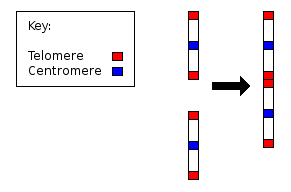
No other human chromosomes have telomeres anywhere other than at the ends of the chromosomes.
Note: I certainly want to know all sides of the story, but I hope I will never have to entertain the “God put them there to test our faith” argument, especially given this specific set of evidence.
Intelligent Design – A Non Issue (to Collins and I agree):
Intelligent Design advocate would argue that evolution is fundamentally flawed, since it cannot account for the intricate complexity of nature. Therefore, there must be an intelligent designer who stepped in to provide the necessary components. aka “Irreducible Complexity.” But in doing so, it creates a “god of the gaps” – that which you do not know can only have been created intelligently by god.
Complexity of the Eye – But it has been independently derived at least 7 different times.
Bacterial flagellum – Proponents argue that the bacterial flagellum’s 34 components that necessitate its function could not have been derived concurrently; at least, the probability is near impossible. But it is “refuted on the general grounds that one does not invoke intelligent causes when undirected natural causes will do.” – William Dembski. Recent studies suggest that its parts are compilation of individual proteins that used to conduct independent functions.
The Intelligent Design was a reaction to evolution, not the other way around, to what Charles Darwin said: “If it could be demonstrated that any complex organ existed, which could not possibly have been formed by numerous, successive, slight modifications, my theory would absolutely break down. But I can find out no such case.”
And here’s what St. Augustine said about the God of the Gaps concept:
“In matters that are so obscure and far beyond our vision, we find in Holy Scripture passages which can be interpreted in very different ways without prejudice to the faith we have received. In such cases, we should not rush in headlong and so firmly take our stand on one side that, if further progress in the search for truth justly undermines this position, we too fall with it.”
Pointers, not necessarily proofs, to God from nature:
There is something instead of nothing.
The unreasonable effectiveness of mathematics.
The Big Bang (something out of nothing?)
The Moral Law – Where does the concept of right and wrong, consistent throughout generations and cultures, come from? Scientists cannot explain the reason behind radical altruism using evolutionary principles. Evolution has no power over a species if the entire species stays static. The only way evolution has any chance to advance, is if some members of the species do better than others. Anything that causes the species to be equally sucessful is going to be a disaster. Radical altruism, personified by Oskar Schindler, Dirk Willems and Captain Richard Phillips, is an example to the contrary to that evolutionary notion. (Dirk Willems was a martyred Anabaptist who is most famous for, after his escape from prison, turning around to rescue his pursuer, who had fallen through thin ice while chasing him. He was executed 4 days later). Those examples, according to evolutionary theory, should incite ridicule; instead, admiration and aspiration abounds.
The-Fine-Tuned Universe. The most compelling argument for me. “The fine-tuned Universe is the idea that the conditions that allow life in the Universe can only occur when certain universal physical constants lie within a very narrow range, so that if any of several fundamental constants were only slightly different the universe would be unlikely to be conducive to the establishment and development of matter, astronomical structures, elemental diversity, or life as it is presently understood.” There are 26 such dimensionless fundamental physical constants, numbers that you can’t derive, they just are.
For example, if the gravitational constant was 1 X 10^14 weaker, then the Big Bang would have created an infinitely diffused universe that couldn’t have sustained life. A little stronger, and the universe would have collapsed upon itself after the Big Bang.
So you have 2 options:
1) There is an infinite number of parallel universes that you cannot measure, and we happen to live in the universe with the right set of 26 physical constants that makes life possible.
2) The constants were set on purpose.
Essentially, the fine-tuned universe idea “implies that either a God created the universe or there is an infinite series of universes…choosing one or the other requires the same faith as both are scientifically untestable as the other.”
Theistic Evolution – (or BioLogos: Bios = Life, Logos = The Word. Or God speaking life into being)
So this bring us to Francis Collin’s hypothesis:
“Almighty God, who is not limited in space or time, created a universe 13.7 billion years ago with its parameters precisely tuned to allow the development of complexity over long periods of time. God’s plan included the mechanism of evolution to create the marvelous diversity of living things on our planet. Most especially, that creative plan included human beings. After evolution had prepared a sufficiently advanced “house” (The human brain), God gifted humanity with the knowledge of good and evil (the Moral Law), with free will, and with an immortal soul. We humans used our free will to break the Moral Law, leading to our estrangement from God. For Christians, Jesus is the solution to that estrangement.
If the Moral Law is just a side effect of evolution, then there is no such thing as good or evil. It’s all an illusion. We’ve been hoodwinked.”
So think about it. Is evolution still a non-issue to you and your religious life? Why? And conversely, do you choose to believe that we happen to live in 1 of infinite set of universes that happens to sustain life? Why?