[My note on 2012-Dec-28: I am not happy with the language I used here to depict John Piper and Albert Mohler’s positions. However, in order to maintain the theme of this blog, which is centered on honesty and transparency, I have decided to leave the original language as is. I hope you will learn from it, as I have, on how not to go about putting together arguments that are devoid of love.]
Back in February, someone in my company emailed about a Powerball drawing when it was $170M. I thought about all the things I could do with even 1% of that money. I would probably quit my job and go to seminary full time. I am quite jealous of countries like Germany where they will pay for much of your tuition that you can do that much more easily, which is one of the reasons why my brother and sister-in-law love that country so much. I dislike having to come back home at 7PM or later everyday, struggling with my homework, without a Friday night or a Saturday to spend on anything other than attending classes. So much so that I think it’s having a detrimental impact on both my professional and academic careers. So without thinking much about it, I contributed $2 to the office pool. It’s not much money to lose so why not?
Most recently, Megamillions jackpot was at a record $640M. That same person coordinated another office pool. This time, I saw more reaction from more evangelicals, John Piper and Albert Mohler being two that I’ll mention here. They listed several reasons why they’re against the lottery, many of which I disagreed with for pretty simple reasons.
Al Mohler is against the lottery, which he calls “gambling,” for “its treatment of the poor. Rather than offering genuine hope and a way out of poverty, gambling operators prey on those who are most desperate… The concentration of lottery ticket outlets in lower-income neighborhoods is no accident.” But this is a horrible, horrible logic, which I would have expected more from Mohler (By the way, I’m sure I’m much more fallible than Mohler is, but this was just a strikingly foolish). This foolish logic can be easily illustrated by applying the same logic to religion that he so much advocates. Karl Marx, for example, said that “religion is the opiate of the masses,” masses here meaning the lower class. Anyone else can take Mohler’s logic and say, for example, that “The concentration of churches or people with religious beliefs in lower-income neighborhoods is no accident. Therefore, religion is simply preying on the poor.” He wouldn’t believe that statement for a second, so why should anyone accept his? Also, would he approve of the statement that “religion preys on the stupid,” and that “the concentration of people with lower IQ with religious beliefs is no accident?”
Simply put, Mohler has abandoned the basic philosophical principle that correlation does not mean causation. He has also abandoned the principle that the concentration of, or distribution of, different stances on ethical issues and other statistics have absolutely nothing to do with the ontology of absolute morality, much less truth. Even if every single living person in Germany believed that Holocaust was right, that opinion has absolutely nothing to do with whether it’s right or wrong. (Also, even if every single person in the world believed that the Holocaust never happened, it doesn’t take away from the truth that it did indeed happen).
But John Piper is even worse. He lists 7 reasons why gambling, and therefore lottery, is wrong, and I’ll show his fallacious reasoning for each of his reasons 3 to 7.
3. It’s a fool’s errand.
The odds of winning are nearly 176 million-to-one. You take real money and buy with it a chance. That chance is so infinitesimally small that the dollar is virtually lost. 175,999,999 times. The smaller amounts paid out more often are like a fog to keep you from seeing what is happening.
So the Megamillions jackpot was at $640M. What if I could have purchased 176 million different tickets to ensure 100% possibility that I would win? Spending $176M to earn $640M would sound like a great investment to anyone, and would not be considered a fool’s errand at all. Also, any elementary mathematician, much less a student of game theory, would say it’s much more foolish to not participate in a lottery that would payout 3.6 times what I pay in. ($640 payout / 176 in 1 probability = 3.63). Piper’s reasoning is much more foolish than the participation of the lottery itself. Gambling with slot machines, for example, would be a little less than 1-to-1 payout to pay in ratio, with the house winning more often. Therefore, 1-to-3.6 ratio in my favor is certainly not foolish.
4. The system is built on the necessity of most people losing.
The Lottery is just another form of gambling (without any of the glamour and glitz of Las Vegas, of course). The “house” controls the action, the players will all eventually lose. (See International Business Times)
Yes, but you could say that about anything in life. To crown an NFL champion, for example, that necessitates 31 teams to lose. Beauty pageants, presidential races, other sport games, all necessitate everyone except one person or one team to lose. Why not condemn anything and everything in which most people end up losing?
5. It preys on the poor.
It supports and encourages “yet another corrosive addiction that preys upon the greed and hopeless dreams of those trapped in poverty. . . The Consumerist suggested that poor people in the U.S. — those earning $13,000 or less — spend an astounding 9 percent of their income on lottery tickets. . . making this ‘harmless’ game a ‘deeply regressive tax.’” (International Business Times)
Again, another fallacious argument, but I’ll need to dive into two different variables here that Piper doesn’t address at all. First, if Piper is saying that it preys on the poor because poor people spend a lot of money RELATIVE to their income, is the morality of gambling or lottery based on spending relative to income? If so, why not simply ask them to spend less money on gambling? Furthermore, would it be any less wrong if every person of every income spent the same proportion on lottery tickets? Furthermore, why is it less wrong to tax more the “rich” that are “job-creators” for the poor; is the income tax system no less “preying” on the poor in that sense? And lastly, why is a person’s voluntary participation on a “regressive tax” any less wrong than a mandatory participation on an income tax?
Piper’s argument, which Mohler also echoed, is desperately fallacious.
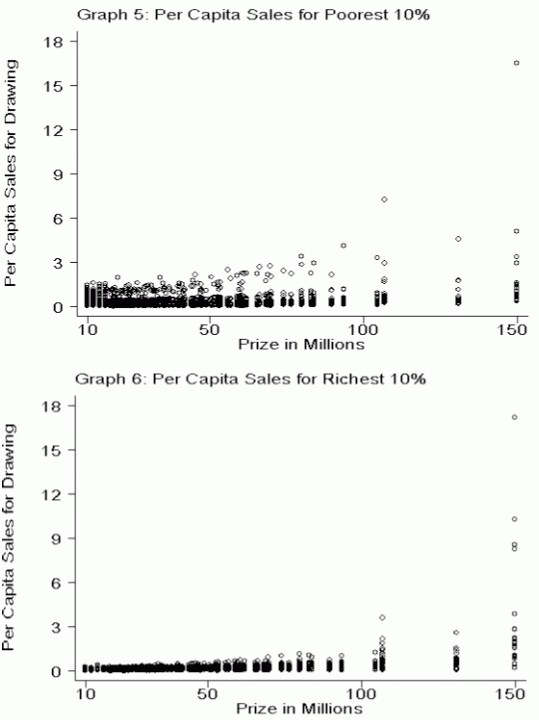
Second, if Piper is saying that it preys on the poor because poor people spend a lot of money in ABSOLUTE terms in comparison to the rich, then he’s also wrong there. Harvard University’s 2002 study, entitled Dreaming Big: Why Do People Play the Powerball?, shows that the poor does spend more money, but it’s nowhere near as big as people may suspect. They write, “It is clear from these graphs that the poorest zip codes purchase more tickets at the lowest jackpot levels. However, at the highest jackpots the sales are about the same.” It’s also clear to me from looking at the graphs that the participation level at lower payouts are dismally small and the variation between the top 10% and bottom 10% income levels are so minute to be of any significance:
6. There is a better alternative.
A survey by Opinion Research Corporation for the Consumer Federation of America and the Financial Planning Association revealed that one-fifth (21 percent) of people surveyed thought the lottery was a practical way to accumulate wealth. We are teaching people to be fools.
If the $500 a year that on average all American households throw away on the lottery (see above) were invested in an index fund each year for 20 years, each family would have $24,000. Not maybe. Really. And the taxes on these earnings would not only support government services, but would be built on sound and sustainable habits of economic life.
But this says absolutely nothing about whether gambling or lottery is right or wrong, simply that it’s better to invest the money rather than to gamble with it. This proves nothing, although I do concede that his article is less about right and wrong and more about reasons to avoid gambling.
7. For the sake of quick money, government is undermining the virtue without which it cannot survive.
A government that raises money by encouraging and exploiting the weaknesses of its citizens escapes that democratic mechanism of accountability. As important, state-sponsored gambling undercuts the civic virtue upon which democratic governance depends. (First Things, Sept., 1991, 12)
Three things to note here. First, citing a religious organization’s article (you can read the whole thing here) which has absolutely no source nor statistical data nor any concrete study in this matter is not extremely convincing. It’s nothing more than an editorial commentary than an article worthy of noting. Second, how does the government “escape the democratic mechanism of accountability” by associating itself with gambling? Does the participating party not give consent by paying for a service? Exactly what accountability is required here and why? Third, the article says that the government “depends” on gambling. Piper turns this relative dependence from this article to absolute dependence, claiming that the government “cannot survive” without it. I think he’s referring to the virtue of accountability and not gambling, and either case he will have to make a better case than pure conjecture, expanding on my second objection.
So with all that in mind, what did I end up doing with the Megamillions drawing for $640M?